
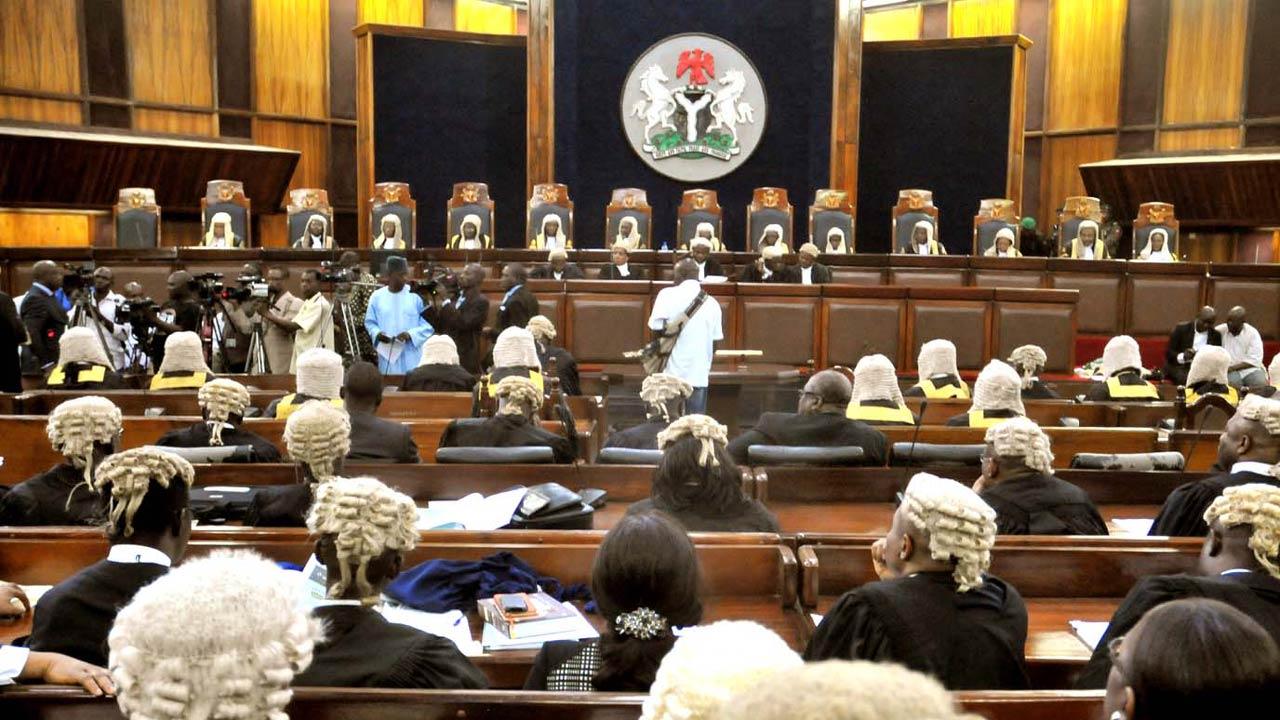
In this report, Vanguard’s Law & Human Rights examines the present composition of the Supreme Court and the extent of compliance by the appointing authorities with the provisions of sections 230(2), 231(3) and 14(2) of the 1999 Constitution in the appointment of justices to the apex bench between 1999 and 2023 with a survey of stakeholders on the concomitant impact of past appointments on the quality of judgments emanating from the apex court and its public image in the last 24 years with recommendations on how about a dozen vacant seats at the Supreme Court bench should be filled in the next few months .
By Ise-Oluwa Ige
Background Facts
On October 27, 2023, a retiring justice of the Supreme Court, Justice Dattijo Muhammad raised the alarm in Abuja that with his exit, the number of justices serving on the apex court had dropped to 10, it’s lowest in the contemporary history of the court. He spoke at the valedictory court session organised by the Supreme Court of Nigeria (SCN) in his honour during which he also raised a flag on a number of corruption-related issues in the judiciary which he said required urgent attention.
The Chief Justice of Nigeria (CJN), Justice Olukayode Ariwoola had himself at another forum last year, disclosed that the apex court has been battling with workload crisis arising from manpower shortage, explaining that the situation gets worse for the third arm of government because in every little disagreement, Nigerians rush to court and in every lost case, they rush to appeal even up to the Supreme Court, no matter how little the issue might be.
He said that alone, had obviously accounted for the several appeals pending in the Supreme Court, adding that though the court receives scathing criticisms from members of the public over its over-bloated docket, yet the institution is neither in any position to regulate case inflow to the court nor has the supernatural powers to attend to all in one-fell-swoop.
Whereas, Section 230 (2) of the 1999 Constitution allows the sitting President to appoint a CJN and other justices of the Supreme Court not exceeding 21, the highest number of justices appointed to the Supreme Court ever was 20 since the constitution was promulgated into law.
Specifically, that history was made on November 6, 2020 when eight newly appointed Justices of the Supreme Court were sworn into office, upping its membership from 12 to 20.
Vanguard reports that all through the tenure of Justice Muhammad Lawal Uwais between 1995 and 2006 and the first quarter of 2020 during the tenure of the immediate past Chief Justice Tanko Muhammad (2019-2022), the highest number of justices appointed to the apex bench was 17.
However, most times, the number of justices on the Supreme Court oscillated between 11 and 14 all through the 1995 and 2022 legal years.
Besides, while Section 14 (2) of the 1999 Constitution requires that the composition of the Supreme Court like all agencies of the government of the federation, shall be carried out in such a manner as to reflect the federal character of the country, as at today, the Supreme Court is presently composed of 10 justices from only four geo-political zones of the country.
Specifically, the Supreme Court is presently composed of the Chief Justice of Nigeria, Justice Ariwoola and nine other justices from only four geo-political zones of the country.
The nine other justices are Kudirat Kekere-Ekun, Uwani Aji, John Inyang Okoro, Lawal Garba, Helen Ogunwumiju, I.N. M. Saulawa, Adamu Jauro, Tijjani Abubakar and Emmanuel A. Agim.
Of the 10 serving justices, three are from the South-West, three from the North-West, two from the North-East and two from the South-South.
The demography of the top judicial officers showed that both the South-East and North- Central are presently not represented on the apex bench.
Vanguard Law and Human Rights reports that between November 6, 2020 when the membership of the apex bench increased from 12 to 20, mandatory retirement and death had depleted the figure to 10.
Elevation of Appeal Court to Supreme Court
Besides, even though Section 231 (3) of the 1999 Constitution provides that a person shall not be qualified to hold the Office of the CJN or a Justice of the Supreme Court unless he is qualified to practise as a legal practitioner in Nigeria for a period not less than 15 years, the present Supreme Court has merely promoted justices of the Court of Appeal to the Supreme Court bench to fill vacant seats instead of appointing qualified candidates from the bench, the bar and the academia.
All past Chief Justices of Nigeria from the time democracy berthed in May 1999, who had the opportunity to recommend best brains, including super lawyers and serving judges with impeccable record as the old Supreme Court in Lagos did to fill available vacancies at the Supreme Court during their tenure, failed to so do but merely promoted justices of the Appeal Court to the policy court.
The past CJNs are Justice Muhammad Lawal Uwais (1995-2006); Justice Salisu Modibbo Alfa Belgore (2006-2007); Justice Idris Legbo Kutigi (2007-2009), Justice Aloysius Iyorger Katsina-Alu (2010-2011); Justice Dahiru Musdapher (2011-2012); Justice Aloma Mariam Muhktar (2012-2014); Justice Mahmud Mohammed (2014-2016); Justice Walter Nkanu Onnoghen (2017-2019) and Justice Ibrahim Tanko Muhammad (2019-2022).
Although some of them, upon elevation to the CJN seat, promised to consider exceptional candidates from the bar and the academia, they always opted for the old criterion when it was time proper to fill the vacant seats at the Supreme Court.
Politics
According to a former Attorney-General of Abia State, Prof. Awa Kalu, SAN, in a chat with Vanguard Law and Human Rights, the appointing authorities appeared to have deliberately downplayed merit and the interest of the country for politics in appointing the best brains into the apex bench.
According to him, that conversation on diversifying sources of recruitment for the bench in Nigeria, be it in high court, the bench of the Court of Appeal as well as the Supreme Court bench, had been there for a while now.
He recalled a meeting of the Body of Senior Advocates (BOSAN), some years back where the body took a decision to approach the then Chief Justice of Nigeria, Hon Justice Katsina-Alu, who is now late, to use his good offices to diversify the Supreme Court rather than have just more or less career judges.
“I was not at that meeting but I learnt BOSAN deliberated on the need for his administration to bring people from the academia, and other sources to enrich the breadth of knowledge and expertise available at the Supreme Court,” Prof. Kalu, SAN said, adding that in the end, BOSAN decided to pick him from the South-East and Tony Idigbe from the South- South and recommended them to the Chief Justice for appointment to the Supreme Court.
He said moments after BOSAN communicated its decision to the then CJN for his action, the decision did not make judges, particularly at the Court of Appeal, at the time, happy.
“And before you knew it, there was commotion at the time arising from the collision between the CJN and the then President of the Court of Appeal which left a lot of questions unanswered particularly about this kind of idea of bringing people from the bar to enrich, not to destroy the Supreme Court.
“It was the argument of some of them that you cannot migrate. They put it very notoriously: You can’t go and pack money as Senior Advocate and you come again and deprive people of their entitlement. So, if you are in practice, remain in practice. If you are on the bench, remain on the bench. How then do you brew the law?” he added.
Another lawyer who does not want his name in print also said that apart from the politics of not going outside the bench to populate the Supreme Court bench, the process of appointment into the Supreme Court itself has been personalized by successive CJNs to the extent that it does not matter the level an appointment process has reached, when a new CJN is sworn in, he cancels what his predecessor had done and begins his own appointment process afresh.
The lawyer who said Nigerians needed not to look far said soon after some of the justices serving on the Justice Tanko Muhammad led 20-member Supreme Court retired, the CJN set an engine in motion to replace the retired justices and that the Federal Judicial Service Commission (FJSC) had already shortlisted candidates and sent same to the NJC to recommend from the list to President Muhammadu Buhari but that he could not complete the process before he was kicked out of the bench.
He said instead of his successor, Justice Ariwoola, to continue where Justice Tanko stopped, the new CJN started the process afresh with a notice issued to both the Nigerian Bar Association and the President of the Court of Appeal to nominate candidates afresh for the vacant seats at the apex bench.
The notice terminated the process which commenced about two years ago during the administration of ex-Chief Justice Tanko Muhammad.
The lawyer said the former CJN, Justice Tanko also did the same when he took over from his predecessor, Justice Samuel Onnoghen even as he claimed that their predecessors also did similar thing.
Consequences of violation on S’Court Justices’ Appointment
Stakeholders are contending that the apparent politicisation of the appointment of judicial officers into the apex bench has begun to take its toll on the quality of judgments emanating from the court lately.
For instance, they posited that the Supreme Court case law is now replete with errors, low with muddled depth of jurisprudence, bereft of scholarly analysis, while the public perception of the court is at a low ebb.
According to a Professor of Law and former Dean of Law Faculty, Lagos State University, Mike Ikhariale, “There is no denying the embarrassing fact that the Nigerian Judiciary is currently on trial in the court of public opinion because of the controversies that have trailed some of the incongruous and logically reprehensible decisions that the apex court and courts below it have delivered in recent times.
“All decent societies hold their judges in the highest possible esteem, almost as if they are demigods. The corollary of that extremely high societal regard is that they are expected to be incorruptible, beyond reproach and decently comported, capped with intellectual acuity.
“That certainly explains the usual deep sense of shock and disappointment by members of the society whenever a judge is found wanting either by manifesting awful jurisprudential incompetence or indulging in disgraceful misconducts such as bribery and corruption.”
Ikhariale blamed the present situation of promoting justices of the Court of Appeal to the apex bench on what he called the self-serving and nepotistic empire-building instincts of those charged with the sacred responsibility of nominating justices into the Supreme Court that have incestuously cornered it in favour of those already holding judicial appointments as if it were a vocational cult or a secret society.
“That institutionalised aberration has unwittingly denied the nation the services of some of her best legal minds while at the same time promoting a myopic and mediocre judicial outlook,” he had fumed.
Expectations
As arrangements are in the pipeline to appoint new justices to the court, stakeholders are urging the CJN to take into consideration all the observed anomalies in past appointments by making sure that the best brains now get appointed to the Supreme Court.
According to a Professor of Public Law and President of the Centre for Socio-Legal Studies (CSS), Prof. Yemi Akinseye-George, he said whereas, judicial appointments under the Constitution are reserved for legal practitioners of verifiable integrity with no restrictions whatsoever as to their areas of legal practice, no lawyer was directly appointed to the Supreme Court as it happened in the past to make for plurality of views.
“For me, I think we need to make the Supreme Court more plural. We need to have at least an academic or two because the way the academics think is different from the way judges think.
“So if you bring in a few academics, that will spice up the court and they will kind of bring in the outside-the-box thinking unlike now when we rarely find dissent and dissent are necessary for orderly development of the law.
“We hardly find dissenting opinions at the Supreme Court these days. It wasn’t so in the past. A situation in which every Justice will be agreeing at all times is not okay for the proper development of the law.
“In a court of 21 justices, we can concede maybe 75% to judges while the remaining 25% can be conceded to senior lawyers and academics who have never been judges so that we can spice up the court,” he advised.
Also offering his advice, Prof Kalu said he expected the current administration to consider picking candidates from both the bar and the academia in filling the various available vacant seats in the Supreme Court.
According to him, “I recalled that Prof Nwabueze (SAN), a long time ago, had written so powerfully about the dangers of our judiciary becoming a career. That is to say, you come in as a magistrate and then you end up at the Supreme Court which has happened to so many people there,” he said adding that the Supreme Court had had people from outside the court system without doing damage to it.
“Prof Taslim Elias who even went to the International Court of Justice and became its President was a distinguished academic. He was the Dean of the Faculty of Law at the University of Lagos. And from there, he became the Attorney-General of the Federation and thereafter came to the Supreme Court. He did not destroy the Supreme Court. He actually elevated the Supreme Court. Late Dr Augustine Nnamani. He was an Attorney-General and also came to the Supreme Court. There are so many others like that. There was a Prof who came from the University of Nigeria. He started at the High Court and came up to the Court of Appeal and later to the Supreme Court. He did not destroy that court. So, the point that has to be understood and I’m serious about it. Somebody who has never been a judge can do well at the Supreme Court. All it takes is the knowledge and the wherewithal to apply that knowledge.
“In local parlance, they say you can’t stand in one place to watch a masquerade. The masquerade itself, as it is dancing, it is changing positions and at times locations. So, if you want to see the masquerade in full, you have to follow it. And that is what has happened to Law.
“There are people who have specialized in Banking. There are people who have specialized in Commercial Law. There are some who specialize in Labour Law and so on. So, the law has, at least, 200 sophisticated branches. So, if you now want each branch of the law to be represented at the apex court, as well as the intermediate court which is the Court of Appeal, you have to bring people from different specializations.
“If you want to cook Ogbono soup, it has a specialist. Egusi soup has specialist. Afhan has specialist. Ewedu has specialist. And so, if you come to the Supreme Court, and it is only Ogbono soup that you have, the law in general will be bereft in certain respect. So, that is the thinking of many people,” he added.
KNOW YOUR RIGHTS SERIES
does efcc have legal backing to search premises, arrest at night?
DO YOU KNOW?
1. The Economic and Financial Crimes Commission, EFCC, is saddled with the duty to investigate and prosecute all financial crimes in Nigeria.
2. In the performance of its duties, the EFCC has the same powers as the Police. (S. 41 of the EFCC Act, 2004).
3. Before the EFCC can search a premises, a warrant must be issued for that purpose by a Judge.
4. A search of a premises or arrest of a person can be done at any time and on any day including a Sunday or public holiday except otherwise specified in the warrant. (Ss. 43 & 147 of the Administration of Criminal Justice Act, ACJA 2015).
5. When carrying out a search, the operatives of the EFCC must notify the occupants of the house their names and the name of the EFCC office they are attached to; state the reason for the search; explain their authority to carry out the search and be on uniform with a valid means of identification. S.s 50 & 51 of the Police Act.
6. If denied access into a premises to carry out a search or effect an arrest, the EFCC may resort to the use of a reasonable amount of force. Ss. 149, 9, 10, 12 & 13 of ACJA.
7. Courts do not have the power to refrain the EFCC from carrying out their functions. (Ewulo v. Economic and Financial Crimes Commission & Ors (2015) LPELR-40912(CA))
8. Any person negatively affected by these actions of the EFCC may commence a lawsuit asking the court to stop searches of premises and arrest at night.
For more information, please contact kokcy29@gmail.com
with KOKO ASUQUO
kokcy29@gmail.com
EDITORIAL
Ise-Oluwa Ige
Innocent Anaba
Ikechukwu Nnochiri
Henry Ojelu
– Vanguard
